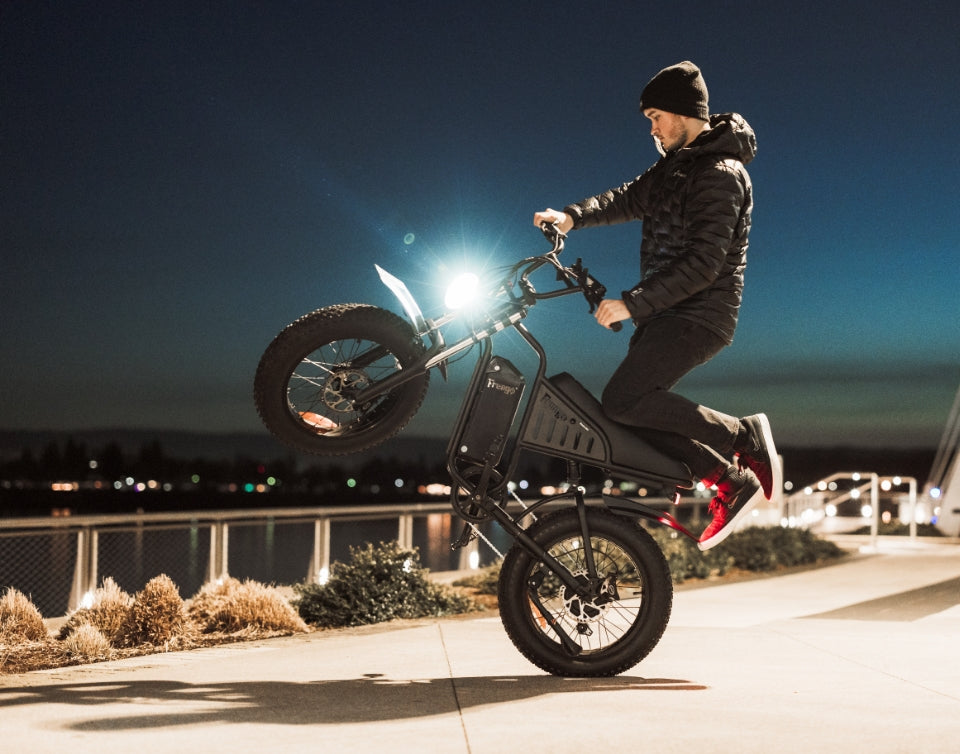
Quick answer: an e-bike controller receives the rider’s request and regulates electrical delivery from the battery to the motor. When you operate the throttle, you send an input signal rather than directly passing the motor’s power through the handlebar. The controller interprets that input according to the system’s design, settings and operating conditions.
This helps explain why two electric bikes can respond differently even when their motors have similar advertised power. The motor matters, but so do the battery, controller configuration and complete vehicle.
Freego’s X0 and X2 Pro offer useful examples of different riding formats. Understanding what their controls request—and what the electrical system delivers—makes product specifications easier to interpret.
What an E-Bike Controller Actually Controls
The battery stores energy, the motor produces rotation, and the controller manages the electrical connection between them.
An e-bike controller is therefore more than a simple on/off switch. It regulates motor operation in response to inputs from the components fitted to the vehicle.
Those inputs may include a throttle, pedal-assist sensor, display commands or other signals. The available inputs and their functions vary by model.
| Component | Main role | What it does not tell you by itself |
|---|---|---|
| Battery | Supplies electrical energy | How sharply the bike will accelerate |
| Throttle | Provides a rider input | The exact power delivered at every position |
| Controller | Regulates motor operation | Whether the complete vehicle suits a particular rider |
| Motor | Converts electrical input into rotation | The complete bike’s range or handling |
| Display | Presents information and may provide controls | Every electrical value inside the system |
Keeping these roles separate prevents a common mistake: attributing every change in riding response to the motor alone.
What Happens When You Twist the Throttle
The throttle provides a signal that represents the rider’s request. The e-bike controller uses that input within its configured operating system.
The resulting response depends on how the system translates the request. Different control approaches can regulate different quantities, such as motor drive voltage or current. Consequently, the same percentage of throttle movement does not have a universal meaning across all electric bikes.
A halfway-open throttle should not automatically be interpreted as half the advertised motor power, half the maximum speed or half the available wheel torque.
Grin Technologies distinguishes between voltage, torque and current-oriented throttle approaches in its motor-system tools. These are general control concepts, not confirmation of which strategy a particular Freego version uses. See Grin Technologies motor simulator documentation.
For the rider, the practical lesson is straightforward: become familiar with the response of the exact bike rather than assuming that experience with another throttle-equipped vehicle will transfer perfectly.

The Throttle Is a Request, Not a Direct Power Cable
A useful way to understand an e-bike controller is to separate the signal path from the power path.
The rider operates a control at the handlebar. The electrical drive system then manages the energy needed to turn the motor.
That distinction matters when reading product descriptions. A particular throttle shape does not establish how much motor power is available or how quickly that power is introduced.
It also explains why replacing a throttle is not simply a matter of choosing a connector that looks similar. Compatibility includes the signal characteristics, wiring and controller requirements of the exact vehicle.
Owners should use manufacturer-approved parts and procedures. A familiar plug shape is not sufficient evidence that two components are interchangeable.
How the Controller Works With a Brushless Motor
In a brushless drive, electronic switching performs the job that mechanical brushes handle in a brushed motor. The controller manages electrical delivery to the motor’s windings in a sequence that produces rotation.
This is one reason the motor and controller need to be matched. They are parts of one operating system rather than independent accessories.
The complete arrangement may use different methods to determine or estimate motor position. Do not assume that all brushless systems use identical sensors, wiring or software.
For general background, Grin Technologies describes the battery, motor, controller and rider-input components as distinct parts of an electric-bike system. See electric-bike components explained.
For Freego owners, understanding this relationship is useful without opening the controller or motor. The relevant ownership tasks are learning the controls, following the manual and recognizing when qualified service is needed.
Battery Current and Motor Phase Current Are Different
Controller specifications can include more than one current figure.
Battery current describes electrical current on the battery side of the controller. Motor phase current refers to current in the motor’s electrical phases.
These values are not interchangeable. A controller can have separate limits for them, and their relationship changes with operating conditions.
That distinction makes a large difference when comparing specifications. Two figures expressed in amps may describe different parts of the system, different durations or different test conditions.
Before drawing a conclusion, ask:
- Is the figure battery current or motor phase current?
- Is it a continuous, nominal or short-duration maximum value?
- Under what operating conditions does it apply?
- Does it describe the controller alone or the complete vehicle?
A larger number without that context is not enough to establish better acceleration or more usable performance.
Why Multiplying Any Amp Figure by Battery Voltage Can Mislead
Voltage multiplied by current gives electrical power when the values describe the same electrical point and operating condition.
The problem arises when unrelated specifications are combined.
For example, multiplying nominal battery voltage by an unspecified controller peak-current figure may mix a battery-side voltage with a motor-side current, or combine figures that do not occur together.
Even a valid electrical input-power calculation is not automatically the mechanical power delivered at the tire. The system has losses, and operating conditions change.
Use the manufacturer’s stated motor ratings for their intended comparison, while keeping nominal and peak values separate. Ask for clarification when a controller rating does not identify its measurement basis.
An e-bike controller specification should help explain the system—not become a shortcut for inventing an output claim.

Freego X0 Shows How to Read Controller Specifications Carefully
The U.S. Freego X0 product page lists a brushless motor controller with 45A nominal and 180A peak figures. It also identifies a full-twist throttle and throttle-only motor activation without a pedal-assist sensor.
The published motor rating is 2,000W nominal and 3,600W peak, with a rear brushless DC hub motor. See the Freego X0 U.S. specification.
These figures should be read within their stated categories.
The controller’s amp figures do not independently prove a new motor-output figure. Unless the manufacturer specifies the electrical measurement point and conditions, do not label the larger number as continuous battery current or use it to calculate a different advertised wattage.
For a prospective X0 owner, the operating format is equally important. A throttle-operated mini moto requires deliberate control familiarity, appropriate rider fit and a suitable riding location. Its compact dimensions do not establish readiness for every beginner.
Freego X2 Pro Shows Why Pedals Add Another Question
The Freego X2 Pro is offered as a pedal-equipped electric dirt eBike. Its published U.S. motor specification identifies a rear brushless hub motor with 3,000W nominal and 6,000W peak ratings. See the Freego X2 Pro U.S. product page.
Pedals make it important to ask how rider inputs are handled on the current version.
Do not assume that pedal presence establishes a particular sensor type, assistance strategy or control priority. Confirm the configuration in the documentation supplied with the unit.
Similarly, the display’s mode labels do not explain every internal controller setting. Owners need to know what the controls do in practice and which adjustments the manufacturer permits.
The X2 Pro and X0 illustrate why understanding an e-bike controller begins with the complete operating format rather than one power figure.
Comparing the Freego Examples
| Question | Freego X0 | Freego X2 Pro |
|---|---|---|
| Basic format | Compact electric mini moto | Pedal-equipped electric dirt eBike |
| Published motor location | Rear hub | Rear hub |
| Published motor rating | 2,000W nominal / 3,600W peak | 3,000W nominal / 6,000W peak |
| Key control question | How does the throttle-operated system respond? | Which throttle and assistance functions are supplied with this version? |
| Specification-reading priority | Clarify the meaning of controller current figures | Confirm current-version input functions and permitted settings |
| Ownership priority | Fit, control familiarity and appropriate use | Fit, control familiarity and appropriate use |
The table does not identify a universal winner. It shows how different vehicles can require different questions even when both use rear hub propulsion.
Choose the operating format that fits your needs, then verify the specific configuration.
Why Similar Motor Ratings Can Feel Different
A motor rating does not describe the entire response between your hand and the rear tire.
Controller configuration can affect how a request is introduced and limited. Battery condition, vehicle load, wheel dimensions and riding conditions also influence the result.
For that reason, a bike that responds differently from another model is not necessarily malfunctioning. The systems may be designed differently.
However, a sudden or unexplained change in your own bike’s behaviour deserves attention. Distinguish a normal difference between models from a change in a familiar vehicle.
When contacting support, describe what happened rather than concluding that the controller is faulty. Useful details include the riding mode, battery level, surface, any displayed error and whether the behaviour is repeatable.

Riding Modes Do Not Explain Every Controller Function
A riding mode can change the available operating behaviour, but its name alone is not a technical specification.
Do not assume that every mode changes the same combination of speed, current or response settings. Follow the instructions for the exact model and version.
Likewise, a mode labelled City does not independently establish permission to use a vehicle on a particular road, path or trail.
For buyers, the useful questions are what the mode changes, how it is selected and which settings the manufacturer recommends for the intended use.
For owners, the priority is consistent operation within the supplied instructions. Changing modes should not be used to work around an unresolved mechanical or electrical problem.
The Controller and Battery Management System Have Different Roles
An e-bike controller and a battery management system, or BMS, belong to different parts of the electrical system.
The controller manages motor operation. The BMS is associated with the battery pack.
Their functions interact, but they should not be treated as the same component. A loss of motor output does not automatically identify which part caused it.
Specific protections, thresholds and responses depend on the components and configuration. Do not assume that every Freego model has an identical list of protective functions simply because another vehicle advertises them.
Use the current manual and manufacturer support to establish which functions apply.
Does an E-Bike Controller Provide Regenerative Braking?
Regenerative braking requires a compatible arrangement of motor, controller, battery and system configuration.
The presence of an electronic controller does not prove that regeneration is available. Neither does a particular motor power rating.
Before expecting braking to return energy to the battery, obtain explicit confirmation for the exact model.
Also distinguish regenerative braking from a brake-related motor cut-off signal. Stopping motor assistance when a brake is operated is not the same process as recovering energy.
Do not use a general explanation of controller technology as evidence of a feature that the product documentation does not confirm.
What Owners Should Inspect Without Altering the System
An e-bike controller is part of a matched electrical system. Routine ownership should follow the manufacturer’s inspection and maintenance instructions.
Look for visible cable damage, disturbed connections or changes that require service. Do not open sealed components, probe live connectors or experiment with wiring to identify a fault.
If the throttle does not return normally, response changes unexpectedly or an error appears, stop using the vehicle and follow the support procedure.
A clear report helps support distinguish between a control input, battery issue, wiring problem and another cause. Include the model, version and relevant error information.
Avoid replacing the controller simply because the bike has stopped responding. Diagnosis should establish the cause first.
Why a Higher-Amp Controller Is Not a Standalone Upgrade
A controller has to work with the battery, BMS, motor, wiring, connectors, display and rider controls.
Increasing a limit without verifying the complete system can move the operating demand beyond what another component was designed to handle.
That is why a controller should not be selected from an amp figure alone. Matching the physical connectors is also insufficient.
For Freego vehicles, ask support to confirm replacement compatibility using the exact model and version. Use approved parts and installation procedures.
The purpose of understanding an e-bike controller is to make better ownership decisions, not to bypass the system’s intended configuration.

Questions to Ask Before Choosing a Freego Model
Before comparing controller specifications, define the experience you want.
Do you want a pedal-equipped platform or a throttle-operated mini moto? Can you comfortably operate the controls? Do you have an authorized riding location and a practical way to transport and store the vehicle?
Then clarify the electrical details:
- What rider-input functions are supplied with the current version?
- Which mode settings are intended for the planned use?
- What do the published current figures measure?
- Which adjustments are owner-accessible and approved?
- Where can the correct manual and replacement information be found?
These questions connect the technology to a real purchase decision.
Frequently Asked Questions About E-Bike Controllers
What does an e-bike controller do?
It receives rider and system inputs and regulates electrical delivery to the motor according to the system’s design and configuration.
Does half throttle mean half the motor’s advertised power?
Not necessarily. The relationship depends on the control strategy, settings and operating conditions. Throttle position is not a universal power gauge.
Are battery current and motor phase current the same?
No. They describe different parts of the electrical system. Compare current figures only after confirming their definitions and measurement conditions.
Can I calculate motor output from any controller amp rating?
No. You need compatible voltage and current measurements from the same operating condition, and electrical input power is not identical to mechanical output.
Does every controller have the same protection features?
No. Functions and thresholds vary. Confirm the features of the exact model rather than transferring claims from another product.
Can I install a higher-current controller to make the bike faster?
Do not assume compatibility or a particular result. The complete electrical and mechanical system needs manufacturer-approved matching.
Is a controller responsible whenever the motor stops responding?
No. Several components can produce a similar symptom. Follow the manufacturer’s diagnostic and support process before replacing parts.
Understand the Request Before Comparing the Output
An e-bike controller links rider intent with motor operation. It helps explain why a throttle movement is not a fixed wattage command and why current ratings need context.
The Freego X0 and Freego X2 Pro demonstrate two operating formats worth comparing around your riding needs.
Review the current product specifications and instructions, confirm the controls supplied with your version, and ask Freego about any unclear rating before drawing a performance conclusion.