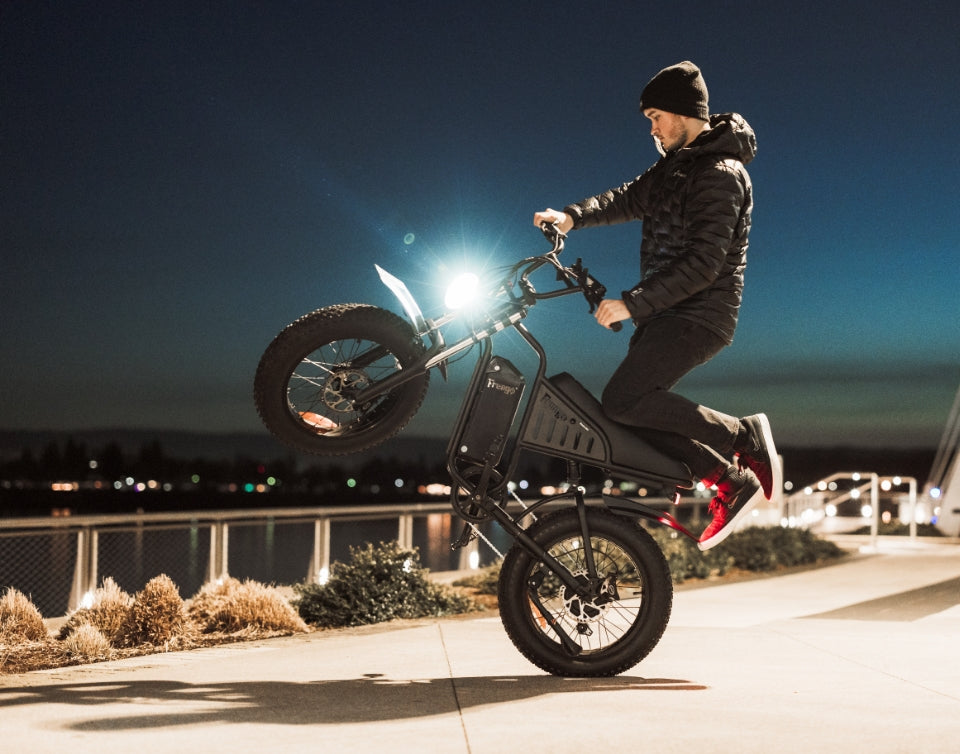
Quick answer: a rear hub motor places the electric drive inside the rear wheel’s hub. It drives the wheel at the hub, delivering electric propulsion without sending motor torque through the pedal chain. A well-matched system can combine strong acceleration, smooth power delivery and quiet electric operation. On pedal-equipped bikes, the rider’s mechanical drivetrain offers another way to turn the same wheel.
For riders, the appeal is practical: substantial electric power with a straightforward drive layout. There is no combustion-engine exhaust note, and no separate external motor-drive chain or belt between a centrally mounted motor and the rear wheel. The result is a compelling format for riders who want an engaging electric ride with fewer exposed motor-transmission parts.
Freego provides useful examples. The X2 Pro combines a rear hub motor with pedals, while the X0 uses a rear hub motor in a throttle-operated mini moto without pedal assistance. Understanding the drive layout makes those differences easier to evaluate.
This guide explains how that power reaches the ground and why the rear hub motor deserves attention for its performance, quieter character and everyday ownership advantages.
Why a Rear Hub Motor Is an Appealing Choice
A rear hub motor brings the drive to the wheel that propels the bike. That simple idea supports several benefits riders can appreciate beyond a specification sheet.
- Strong electric propulsion: hub placement can support powerful off-road platforms as well as lower-powered bicycle applications. The complete motor, battery and controller determine the available performance.
- Quieter electric riding: propulsion comes without combustion pulses or an exhaust system. Motor sound, tires and wind remain part of the experience, but a loud engine is not a requirement for an exciting ride.
- Motor power independent of the pedal chain: on a pedal-equipped hub bike, the electric drive does not load the chain with motor torque. The chain carries the rider’s pedalling effort instead.
- A compact motor-transmission layout: the hub contains the electric drive, avoiding a separate external motor-drive chain or belt that would need its own alignment, tension and lubrication checks.
- Straightforward throttle operation: on throttle-equipped models, riders request propulsion at the handlebar without coordinating a clutch or shifting motor power through a pedal drivetrain.
For a buyer who values a strong, uncomplicated electric riding experience, these are meaningful reasons to consider the layout. They also explain why Freego uses rear hub propulsion on both the pedal-equipped X2 Pro and the compact X0 mini moto.
Where a Rear Hub Motor Sits
The hub is the central part of the wheel, surrounding its axle. In a rear hub motor system, the electric drive is integrated into this area.
From the outside, you may see a larger hub housing and a motor cable near the rear axle. The exact arrangement varies by model, so appearance alone cannot identify every internal component.
The important distinction is location: motor output reaches the rear wheel at the hub rather than first passing through a separate chain or belt from a centrally mounted motor.
This does not mean the bike has no chain. A pedal-equipped bike can still use a chain to transmit the rider’s effort to the rear wheel. The motor and pedal drivetrain serve different roles even though both contribute to moving the same vehicle.
Battery, Controller and Motor Have Different Jobs
A rear hub motor is one part of an electrical drive system. It does not independently decide how much assistance to provide.
| Component | Basic role | What the rider should understand |
|---|---|---|
| Battery | Stores and supplies electrical energy | Capacity and condition affect available energy |
| Controller | Regulates electrical delivery to the motor | Configuration helps shape the response |
| Rider input | Requests assistance or propulsion | Available inputs depend on the model |
| Motor | Converts electrical input into mechanical rotation | Location does not describe the whole bike’s performance |
| Rear wheel and tire | Transfer driving force to the ground | Surface and tire condition still matter |
These parts must work as a matched system. Comparing motors without considering their batteries, controllers and complete vehicle configurations leaves out much of the explanation for how a bike feels.
A motor’s advertised rating is therefore a useful specification, but it is not a complete description of acceleration, range or suitability.

What Happens When You Request Power
On a throttle-equipped vehicle, operating the throttle sends a request to the controller. On a pedal-assist bike, a sensor provides an input associated with pedalling.
The controller then manages electrical delivery to the motor according to the system’s design and settings. In a brushless motor, controlled electrical switching creates the magnetic interaction that produces rotation.
The rider’s input and the resulting wheel response are related, but they are not the same thing. The controller, operating conditions and configuration sit between the request and the output. For background, see Grin Technologies’ explanation of electric-bike components.
For owners, this creates a practical rule: learn the response of your exact bike. Do not assume that another rear hub motor bike will react identically because it has a similar throttle, display or power rating.
Quiet Electric Operation Without Giving Up Power
A quieter ride can still feel lively. Electric propulsion does not need a combustion engine’s intake, exhaust or repeated firing pulses to produce useful wheel torque. A rear hub motor generates its drive through electromagnetic interaction inside the wheel hub.
That gives riders a different kind of enjoyment: the sensation of electric acceleration, with less engine noise competing with the surroundings. There is also no separate external motor-drive chain or belt adding its own transmission sound. A pedal-equipped bike may still have normal pedal-chain noise.
Quiet does not mean silent. Electrical switching, internal gearing where fitted, tire tread, loose gravel and wind can all be audible. Sound also varies with speed and load. Without comparable measured tests, it would be misleading to assign a decibel reduction or declare every hub motor quieter than every mid-drive.
The useful takeaway is simpler: strong propulsion and a quieter electric character can coexist. Riders do not have to choose a loud combustion engine to enjoy an energetic off-road platform.
Not Every Hub Motor Has the Same Internal Design
Rear hub motor describes drive location. Geared hubs use internal reduction gearing; direct-drive hubs do not use that internal gear arrangement. Both package propulsion at the wheel. See Grin Technologies’ hub motor explanation.
Freego’s published rear hub descriptions support the layouts discussed here without establishing a particular internal construction. The benefits of avoiding a separate external motor-drive chain apply without assuming either design.
Does a Rear Hub Motor Use the Pedal Chain?
On a conventional pedal-equipped rear hub motor bike, the rider’s pedalling effort travels through the pedal drivetrain. Motor output reaches the wheel at the hub.
This distinction helps answer a common question: the presence of a chain does not necessarily mean that the electric motor drives through it.
It also explains why changing pedal gearing should not automatically be treated as a way to change the motor’s gearing. The mechanical relationship needs to be understood from the actual design.
For a buyer, the more useful questions are:
- Does this model have functional pedals?
- Does it provide pedal assistance, throttle operation or both?
- How is assistance activated?
- What transmission is fitted to this version?
- What does the manual say about operating the bike without assistance?
These questions reveal more than simply asking whether the bike has a rear hub motor.

Freego X2 Pro Shows How Pedals and a Rear Hub Motor Can Coexist
The U.S. Freego X2 Pro is presented as an electric dirt eBike with pedals. Its published specification identifies a rear brushless hub motor rated at 3,000W nominal and 6,000W peak. Check the Freego X2 Pro product page.
The X2 Pro makes a clear point: a rear hub motor can be the foundation of a powerful electric dirt eBike. Its electric drive turns the rear wheel at the hub, while the pedal drivetrain remains a separate mechanical input. The motor’s propulsion is not dependent on the rider pushing hard on the pedals.
For riders who want an energetic off-road platform with pedals, this arrangement is attractive. Throttle control gives the rider a direct way to request motor output, while the controller shapes delivery. The current U.S. product page also describes pedal assistance, providing another way to activate the electric drive.
Its published power rating demonstrates the capability available from hub propulsion; actual acceleration and climbing performance also depend on load, traction, battery condition and settings. Pair that performance with a fit and control reach you can comfortably manage.
Likewise, pedals do not independently establish where the vehicle may be operated. Confirm the requirements applicable to the specific configuration and riding location.
Freego X0 Shows Why a Rear Hub Motor Does Not Require Pedals
The U.S. Freego X0 specification lists a 2,000W nominal / 3,600W peak rear brushless DC hub motor. It also identifies throttle-only motor activation with no pedal-assist sensor. See the Freego X0 product page.
The X0 shows another advantage of the layout: substantial electric propulsion in a compact mini moto format. Its rear hub motor delivers power without requiring a pedal transmission or a separate external motor-drive chain. That keeps the riding concept focused on throttle input and rear-wheel propulsion.
For riders seeking the feel of a small electric moto, the appeal is easy to understand. Foot supports and a throttle replace the pedalling routine, while the hub provides the driving force. Assess foot position, throttle reach and overall fit to make the most of that format.
Its compact format should not be confused with a universal beginner recommendation. Choosing the X0 still requires a suitable rider, familiarity with the controls and an authorized place to use it.
The comparison with the X2 Pro demonstrates the central point: a rear hub motor describes where propulsion is produced, while the rest of the vehicle determines how the rider interacts with it.
Comparing the Two Freego Examples
| Question | Freego X2 Pro | Freego X0 |
|---|---|---|
| Published electric drive location | Rear hub | Rear hub |
| Vehicle format | Pedal-equipped electric dirt eBike | Compact electric mini moto |
| Published motor rating | 3,000W nominal / 6,000W peak | 2,000W nominal / 3,600W peak |
| Practical hub-drive advantage | Strong hub propulsion alongside a separate pedal drivetrain | Compact throttle-driven propulsion without a pedal transmission |
| What to check before buying | Pedal function, controls, fit and intended use | Throttle control, foot position, fit and intended use |
Both models show that a rear hub motor can deliver meaningful electric performance. Their main difference here is how that propulsion fits into the rider’s preferred vehicle format.
If pedalling is part of the experience you want, investigate the X2 Pro’s current configuration. If you prefer a compact, throttle-operated mini moto format, investigate the X0.
In either case, confirm the specifications of the U.S. version you intend to order. Product revisions and regional listings can differ.

Why Two Rear Hub Motor Bikes Can Feel Different
Hub propulsion can support different riding personalities. Controller settings, battery delivery, wheel dimensions, tire contact, vehicle weight and rider load shape the response.
Choose around the experience you want: smooth starts, energetic acceleration on suitable terrain or a compact moto format. The X2 Pro and X0 offer different ways to enjoy rear-wheel electric drive. Their published ratings help identify the platform, while fit and control feel help you choose between them.
Putting Rear Hub Motor Power to Work on the Trail
A strong rear hub motor gives the rider useful propulsion to work with. Making the most of it means combining progressive throttle input with appropriate tires, pressure and a suitable riding surface.
If the surface is loose, wet or otherwise difficult, additional requested power does not automatically produce useful forward movement. Tire condition, appropriate pressure, rider technique and the suitability of the route remain important.
Progressive input helps the rear tire turn available torque into forward motion instead of unnecessary wheelspin. This lets the rider enjoy the platform’s performance with more deliberate control.
Before extending a ride, learn the bike’s controls in suitable conditions and follow the manufacturer’s guidance. Do not use maximum speed as the starting point for assessing the system.
This matters for both Freego examples. Their different formats still require deliberate control and an appropriate riding environment.
A Simpler Motor Transmission for Ownership
A rear hub motor packages electric propulsion at the wheel, eliminating a separate external motor-drive chain or belt. That means one less exposed drive system to tension, align or lubricate. On a pedal-equipped bike such as the X2 Pro, the pedal chain still needs its normal care, but it does not transmit the motor’s torque.
This separation is a useful ownership benefit. Motor assistance does not add its torque to the pedal chain and sprockets. Wheel, axle and cable checks still matter; use the model’s manual and keep the motor cable protected and correctly routed.
Do not improvise axle hardware, alter retention parts or assume that a replacement wheel is compatible because its diameter appears correct.
When ordering parts, provide the exact model and version. A replacement needs to match more than wheel size: the electrical and mechanical interfaces must also be appropriate.
If rear-wheel removal is unfamiliar, use qualified service. The motor cable and vehicle-specific hardware make it a different task from treating the assembly as an ordinary unpowered bicycle wheel.

Keeping the Quiet, Smooth Riding Experience
The simpler external motor-drive arrangement makes routine ownership more straightforward, while regular whole-bike care helps preserve the smooth electric experience.
The complete bike still requires checks of tires, wheels, brakes, steering, suspension, electrical connections and fasteners according to its manual. A pedal-equipped model also retains its pedal drivetrain maintenance requirements.
Cleaning should protect the electrical system and braking surfaces. Avoid directing high-pressure water at sensitive areas or applying lubricants where they can contaminate brakes.
A change in sound, unusual vibration, damaged wiring or an abnormal response deserves investigation. Do not treat a riding-mode change as a repair.
The right ownership question is what checks the complete model requires and who will perform them.
Questions to Ask Before Choosing a Rear Hub Motor Bike
Start with the format you enjoy: pedals alongside hub propulsion, or a throttle-operated mini moto. Then check seat height, control reach, foot position, loading arrangements and intended riding access.
Review the current manual and parts support before ordering. A good match lets you enjoy the motor’s strengths while handling the complete bike comfortably.
Frequently Asked Questions About Rear Hub Motors
What is a rear hub motor?
It is an electric drive integrated into the hub of the rear wheel. The battery and controller work with it to provide propulsion.
Can a rear hub motor bike have pedals?
Yes. The Freego X2 Pro provides a pedal-equipped example. Pedal presence and assistance operation should be checked separately for the current version.
Can a rear hub motor work without pedals?
Yes. The Freego X0 uses a rear hub motor in a throttle-operated mini moto format without a pedal-assist sensor.
Are all rear hub motors direct drive?
No. Hub motors can use different internal designs. Confirm a model’s construction with the manufacturer rather than inferring it from appearance or power.
Is a rear hub motor bike automatically suitable for public roads?
Motor location does not establish road eligibility. Check the vehicle’s configuration and the requirements of the location where it will be used.
Match the Rear Hub Motor Platform to Your Riding Needs
A rear hub motor offers more than an interesting component location. It brings together strong electric propulsion, a quieter riding character and a straightforward motor-transmission layout.
The Freego X2 Pro combines a powerful hub-drive platform with pedals, while the Freego X0 brings hub propulsion to a compact, throttle-operated mini moto. Both make a positive case for choosing rear hub drive around the riding experience you want.
Compare the Freego X2 Pro and Freego X0 around the experience you want, your physical fit and your intended riding location. Then confirm the current configuration with Freego before choosing.