Freego X2 Pro vs. HappyRun G300 Pro: What the Spec Sheets Don’t Tell You
Share
When shoppers search for Freego X2 Pro vs HappyRun G300 Pro, they usually start with the same numbers: battery voltage, peak wattage, top speed, and price. Those figures matter, but they do not tell the full story of how an electric dirt bike feels after an hour on mixed terrain, how it handles tight corners, how far it realistically travels, or what ownership looks like after the first month.
The Freego X2 Pro and the HappyRun G300 Pro are both all-terrain electric dirt bikes with pedals, powerful hub motors, removable batteries, and off-road capability. The G300 Pro uses a 72V 30Ah battery, a 3,000W nominal motor with 6,500W peak output, a claimed top speed of 50 mph, and a claimed range of up to 70 miles. It also weighs 136.8 lbs.
The Freego X2 Pro takes a different approach. It uses a 3,000W nominal / 6,000W peak rear brushless hub motor, offers either a 60V 30Ah standard battery or a 60V 40Ah Long Range upgrade, and weighs 123 lbs. With the 40Ah pack, Freego rates the X2 Pro for up to 75 miles, compared with the G300 Pro’s 70-mile claim.
So, which one should you buy? If you want the lowest possible entry price and a larger claimed peak-power figure, the HappyRun G300 Pro may appeal to you. If you value a lighter, more agile platform, more battery-choice flexibility, longer rated range, smart features, and a brand focused on rider experience, the Freego X2 Pro is the stronger all-round choice.
Key Specifications Compared
| Feature | Freego X2 Pro | HappyRun G300 Pro |
|---|---|---|
| Motor | 3,000W nominal / 6,000W peak | 3,000W nominal / 6,500W peak |
| Battery options | 60V 30Ah or 60V 40Ah | 72V 30Ah |
| Battery energy | 1,800Wh standard / 2,400Wh Long Range | 2,160Wh |
| Claimed range | 37–56 miles standard; 49–75 miles Long Range | 70+ miles |
| Weight | 123 lbs | 136.8 lbs |
| Top speed | 50 mph off-road mode | 50 mph off-road mode |
| City-mode speed | 28 mph | 28 mph |
| Smart features | Bluetooth speaker, RGB lighting, fingerprint unlock, upgraded display | Performance-focused configuration |
| Best for | Riders who want agility, range flexibility, smart features, and a refined ownership experience | Riders prioritizing a 72V system and lower promotional pricing |
Battery and Range: Why Capacity Matters More Than Voltage Alone
The G300 Pro’s 72V 30Ah battery provides 2,160Wh of stored energy, while the Freego X2 Pro’s standard 60V 30Ah battery provides 1,800Wh. On paper, that gives HappyRun an energy advantage in its base configuration. However, the X2 Pro’s optional 60V 40Ah battery provides 2,400Wh—more usable energy than the G300 Pro’s pack.
That is why the Freego X2 Pro Long Range version can reach up to 75 miles, while the HappyRun G300 Pro is rated for 70+ miles. The difference may look small in a table, but on a long trail day, a commute with detours, or a weekend ride where you do not want to plan every stop around a charger, that extra range creates real freedom.
Freego also gives buyers more control over the purchase. The X2 Pro is available in three versions:
- Standard: 60V 30Ah battery, rated for 37–56 miles depending on terrain, rider weight, speed, and riding mode.
- Long Range: 60V 40Ah battery upgrade, rated for 49–75 miles.
- Smart: Adds a built-in Bluetooth speaker with seven RGB light colors, an upgraded instrument panel, and fingerprint unlock.
The G300 Pro is offered with one 72V 30Ah battery configuration. That simplicity is not necessarily bad, but it means riders who want more range from the factory have fewer options.
Real-world range expectations
No electric dirt bike reaches its maximum advertised range in every condition. Hill climbs, sand, mud, rider weight, tire pressure, wind, throttle use, and temperature all reduce range. The Freego X2 Pro’s published 49–75 mile range for the 40Ah version is based on conditions such as rider weight, terrain, speed, and riding mode, so riders should treat it as a practical upper-range estimate rather than a guarantee.
The same logic applies to the HappyRun G300 Pro. Its 70+ mile claim is based on its 72V 30Ah battery, but independent review coverage notes that hard riding in top modes can produce substantially lower real-world results. That is not a criticism unique to HappyRun; it is simply how high-performance electric dirt bikes work. The important point is that the X2 Pro Long Range starts with a larger 2,400Wh energy reserve, giving riders more margin before range anxiety becomes a problem.
Weight and Handling: The Difference You Feel Every Ride
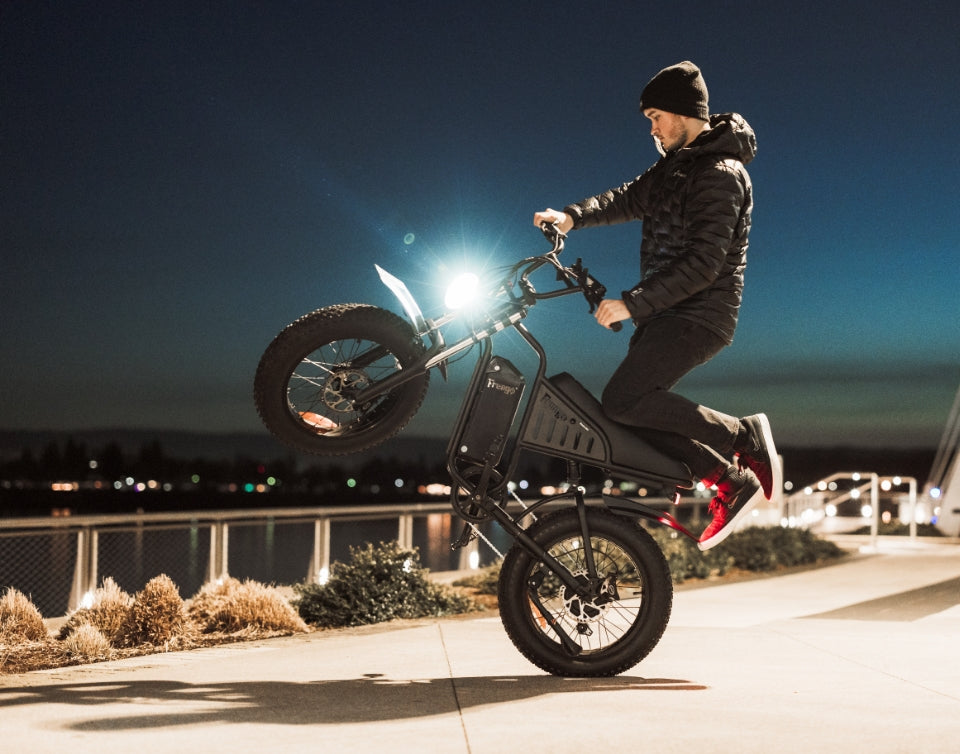
The HappyRun G300 Pro weighs 136.8 lbs. The Freego X2 Pro weighs 123 lbs. That's nearly 14 lbs—enough to notice when lifting the bike, loading it into a vehicle, maneuvering through soft dirt, or changing direction quickly on a trail.
A lighter bike is not automatically better in every situation. Extra mass can add stability at high speed. But for most riders, especially those who ride technical trails, tight forest paths, beach routes, or uneven urban terrain, a lighter machine is easier to control, easier to catch if the front end washes out, and less tiring over a long day.
The Freego X2 Pro’s lower weight also makes it more practical for riders who need to move the bike regularly. At 123 lbs, it is still a substantial electric dirt bike, but it is noticeably more manageable than a 136.8 lb machine when you are navigating a garage, loading rack, apartment stairwell, or campsite.
This is one of the clearest differences in the Freego X2 Pro vs HappyRun G300 Pro discussion: the G300 Pro may win a spec-sheet argument with its 72V system, while the X2 Pro is designed to feel more responsive and rider-friendly in the environments where handling actually matters.
Power, Speed, and Real-World Performance
The HappyRun G300 Pro advertises 6,500W peak power, while the Freego X2 Pro advertises 6,000W peak power. The 500W difference is real on paper, but peak power is a short-duration measurement rather than the continuous power a rider experiences throughout a ride. Motor tuning, controller calibration, battery output, rider weight, traction, and terrain all influence how fast a bike feels in the real world.
Both bikes are rated at 50 mph in off-road mode. Freego also lists the X2 Pro at 28 mph in city mode, matching the G300 Pro’s city-mode rating.
Customer testing also suggests the X2 Pro can exceed its rated top speed under the right conditions. Snowmanmils shared a review video in which his Freego X2 Pro reached 55 mph, available on YouTube. Another customer reported completing three speed tests, with a top recorded speed of 58 mph; check out the video. These are individual customer results rather than guaranteed performance figures.
Price and Value: What the Difference Buys
Price is an important part of this comparison, and it should be stated clearly. HappyRun lists the G300 Pro from $1,799. The Freego X2 Pro is listed at $2,199 depending on the configuration. That means the base G300 Pro can cost less upfront than the base X2 Pro if budget is the primary deciding factor.
Smart Features and Ownership Experience
The Freego X2 Pro Smart version is designed for riders who want more than raw performance. It includes a built-in high-quality Bluetooth speaker for wireless music, seven different RGB light colors, and an upgraded instrument panel. Explore the Smart features and configurations on our YouTube channel.
The X2 Pro most distinctive feature is the fingerprint recognition unlock. The rider’s fingerprint acts as a personal key, supports multiple fingerprint entries, and makes unlocking the bike quicker and more secure than relying on a traditional key alone. These features do not increase motor output, but they make the X2 Pro more convenient for daily use, shared households, commuting, and riders who want a more modern ownership experience.
The HappyRun G300 Pro focuses primarily on core off-road performance and hardware. That is a valid approach, especially for riders who want a straightforward machine at a lower promotional price.
Customer Support and Real Ownership Feedback
A dirt bike is not only a purchase; it is an ongoing relationship with the brand that supports it. Freego provides support by email at support@freegobikes.com, by phone or text at 213-640-6875, and through our official contact page. Freego also offers a 2-year warranty on qualifying structural components.
Customer feedback is an important part of that picture. Freego currently holds a 4.5 rating on Trustpilot, and individual reviews highlight responsive service and fast replacement-part support. Clifton Howard wrote in an October 2026 review that Freego’s customer service was “outstanding and unexpectedly quick” after an issue with his son’s X3, and that the replacement part arrived quickly. You can read his review from this link.
Another customer, Gabe Aldrete Jr., shared in an August 2026 review that Freego team member Rica followed up daily and helped make the process smooth. His review is available here. These are individual experiences, not a guarantee for every buyer, but they illustrate the type of after-sales support Freego aims to provide.
Why the Freego X3 Pro Matters in This Conversation
Many online comparisons focus only on the Freego X2 Pro and ignore the fact that Freego also offers the X3 and X3 Pro for riders who want more power. If the G300 Pro’s 72V 6,500W peak system is the main reason someone is considering it, the Freego X3 lineup is the more direct answer.
The Freego X3 uses a 72V 40Ah battery, while the Freego X3 Pro uses a 72V 50Ah battery. The X3 Pro is equipped with a 4,500W nominal / 8,000W peak rear brushless hub motor, up to 230 Nm of torque, and a 3,600Wh battery pack. Freego rates it for up to 110 miles in city mode at 20 mph with pedal assist and around 40 miles at 45 mph in off-road mode.
That means the Freego X3 Pro does not merely match the G300 Pro’s 72V platform—it exceeds it in peak motor output, battery capacity, torque, and long-range capability. Riders comparing the Freego X2 Pro vs HappyRun G300 Pro should therefore understand that the X2 Pro is not Freego’s only performance option. If raw power and maximum range are the priority, the X3 Pro is the model designed to compete at that level.
Freego X2 Pro vs HappyRun G300 Pro Final Verdict
The Freego X2 Pro vs HappyRun G300 Pro decision comes down to priorities. The HappyRun G300 Pro is a strong value option for riders who want a 72V 30Ah battery, 6,500W peak motor rating, and the lowest possible entry price.
The Freego X2 Pro is the better fit for riders who want a lighter, more configurable bike with up to 75 miles of rated range, smart ownership features, direct manufacturer support, and a 2-year limited structural warranty. And for riders who want to move beyond the X2 Pro class entirely, the Freego X3 Pro offers 8,000W peak power, a 72V 50Ah battery, and up to 110 miles of city-mode range.
Review Freego’s warranty and customer support policy before ordering, then choose the configuration that matches your terrain, range needs, and budget.