

How to Choose an Electric Bike for Short Riders: Fit, Wheel Size, Weight, and Control
Choosing an electric bike for short riders is mainly a fit and control decision—not a contest for the biggest motor or battery. A bike may look compact online yet still feel awkward if the seat is too high, the handlebars are too far away, or the frame is too heavy to balance at a stop. The right choice should let you reach the controls comfortably, put a foot down with confidence, and manage the bike when the motor is off.
Quick answer: The best electric bike for short riders has a published rider-height range that includes you, a manageable minimum seat height, comfortable handlebar and brake-lever reach, and a weight you can control while parking or walking the bike. Smaller wheels can lower the bike, but frame geometry and real-world fit matter more than wheel diameter alone.
Why Fit Matters in an Electric Bike for Short Riders
An e-bike that is too large becomes most difficult at the moments when motor power cannot help: mounting, stopping, turning at walking speed, parking, and moving the bike through a doorway. If you must lean the bike sharply just to touch the ground, or stretch your fingers to reach the brake levers, ordinary stops can feel unnecessarily stressful.
The National Highway Traffic Safety Administration’s bicycle fitting guidance recommends checking three basics: clearance over the frame, a comfortable reach with a soft bend in the arms, and a saddle position that leaves a slight bend in the knee at the bottom of the pedal stroke. NHTSA also notes that your hands should be able to grip the brakes easily. Those principles apply whether the bike uses a traditional frame or a compact moto-style design.
Rider height is a useful first filter, but it is not a complete fit measurement. Two people who are both 5'2" can have different inseams, torso lengths, arm lengths, and hand sizes. That is why a thoughtful electric bike for short riders should be evaluated by both the manufacturer’s fit range and the rider’s contact with the bike.
How to Choose an Electric Bike for Short Riders
1. Start with the published rider-height range
Use the manufacturer’s suggested rider-height range to remove obviously unsuitable models from your list. Do not assume that a visually small bike will fit, and do not treat a broad “one size fits most” statement as a guarantee. The published range is a starting point; riders near either end should check the physical measurements more carefully.
2. Measure your inseam
Stand barefoot against a wall with your feet about shoulder-width apart. Place a book firmly between your legs as if it were a saddle, then measure from the floor to the top edge of the book. This inseam measurement helps you judge frame clearance and whether the saddle can be positioned for comfortable pedaling.
For a step-over frame, you should have clearance when standing over the top tube. For a low or moto-style frame, the minimum seat height and the ease of placing a foot down may be more useful than traditional frame-size labels.
3. Check minimum seat height and pedaling position
A low seat can improve confidence at stops, but the saddle still needs to support an effective pedaling position. When seated with a foot on the pedal at its lowest point, the knee should retain a slight bend. If the knee remains sharply bent, the seat may be too low for efficient pedaling. If the rider must rock the hips to reach the bottom of the stroke, it is too high.
4. Check handlebar and brake-lever reach
Sit naturally and place both hands on the grips. Your elbows should remain slightly bent rather than locked, and you should not have to slide forward to steer. Make sure you can pull each brake lever firmly without releasing your grip. This is especially important on a heavier fat-tire e-bike because stopping confidence depends on both brake performance and the rider’s ability to use the controls.
5. Consider the bike’s total weight
Motor assistance makes a heavy bike easier to ride, but not easier to carry up stairs, lift into a vehicle, recover from a lean, or roll with a depleted battery. For a smaller rider, a difference of 30 or 40 pounds can change whether the bike feels practical every day. Compare net weight with the battery installed whenever possible, and think about your actual storage and transport routine.

Choosing Wheel Size for an Electric Bike for Short Riders
Wheel diameter affects more than appearance. Smaller wheels can help designers lower the frame, seat, and center of mass. They also make a bike more compact for tight turns, storage, and transport. Larger wheels generally roll over rough patches more gradually and may feel steadier at speed, but they can contribute to a taller overall package.
| Wheel size | Potential advantage | Trade-off to check |
|---|---|---|
| 16 inches | Compact proportions, lower seat potential, agile low-speed handling | Can react more quickly to bumps and steering input |
| 20 inches | Common balance of compact fit, stability, and tire availability | The complete bike may still be tall or heavy |
| 26 inches or larger | Smoother rollover on rough pavement and longer-distance stability | May raise the frame and minimum seat height |
Tire width changes the experience again. A wide tire contains more air volume and can add grip and cushioning on uneven pavement. However, a fat tire does not automatically make a bike easy for a short rider. Frame shape, seat height, reach, steering geometry, and weight still determine whether the whole bike feels controlled.
Why the Freego M3 Is a Strong Electric Bike for Short Riders
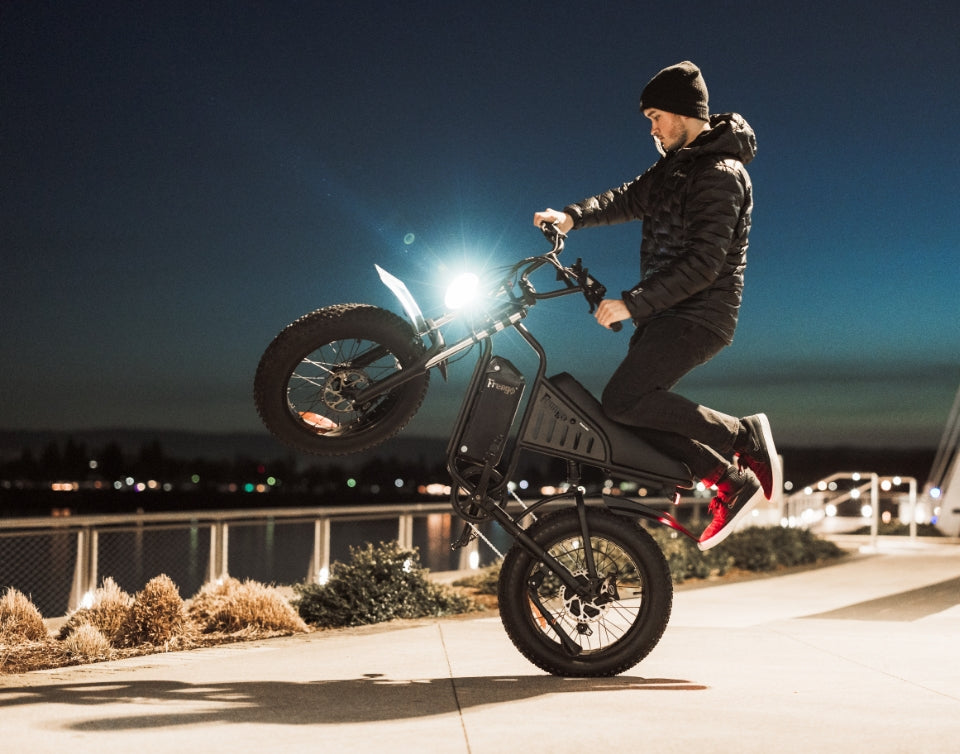
The Freego M3 is the most direct Freego match for riders who want compact dimensions without giving up fat tires or hydraulic braking. Its published rider-height range is 4'7" to 5'11", and its 16 × 4-inch tires help keep the overall package smaller than a typical 20-inch fat-tire model.
The M3 weighs approximately 55 pounds. That matters because an electric bike for short riders must remain manageable when it is not moving. A lighter, shorter bike can be easier to turn around in a hallway, push through a doorway, lift over a curb, or load into a suitable vehicle. The M3 does not fold, so buyers should still measure their storage area or car opening before ordering.
Its 750W motor and 48V 13Ah battery support everyday city and campus riding, while the Class 2 configuration limits throttle operation to 20 mph. Front suspension and 16 × 4-inch tires help soften uneven pavement, and hydraulic disc brakes give the rider progressive braking control. These features do not replace correct fit, but they support the use case: a compact e-bike that is easier to handle without feeling under-equipped.
For new riders, strong acceleration should be introduced gradually. Begin in a low assist setting, apply the throttle smoothly, practice braking in an open area, and learn how the bike responds before riding near traffic. Check local rules for rider age, helmet use, e-bike classes, and permitted riding locations.

Which Freego Electric Bike for Short Riders Fits You: M3 vs F0
The Freego F0 also targets shorter riders, but it solves a different problem. Its published fit range is 4'11" to 5'11", with a listed seat height of 28.9 inches. It uses 20 × 4-inch fat tires, full front-and-rear suspension, hydraulic disc brakes, and a longer bench-style seat.
The major trade-off is weight. The F0 is listed at approximately 104 pounds, nearly twice the M3’s weight. The extra mass and full-suspension structure can feel planted, but they also make the F0 harder to lift, carry, or maneuver with the power off. It is not the first recommendation for a rider who must use stairs or load the bike frequently.
| Fit factor | Freego M3 | Freego F0 |
|---|---|---|
| Suggested rider height | 4'7"–5'11" | 4'11"–5'11" |
| Net weight | About 55 lb | About 104 lb |
| Tires | 16 × 4-inch fat tires | 20 × 4-inch fat tires |
| Suspension | Front suspension | Front and rear suspension |
| Best match | Riders prioritizing compact size, lighter weight, and everyday maneuverability | Riders prioritizing full suspension and a longer seat who can manage a much heavier bike |

Choose the M3 if compactness and manageable weight are the priorities. Consider the F0 if you prefer a larger 20-inch platform, full suspension, and a longer seat—and you have ground-level storage or another practical way to handle its weight. Riders taller than these published ranges can also compare Freego’s broader Class 2 e-bike collection.
Electric Bike for Short Riders Test Checklist
Before choosing an electric bike for short riders, confirm the following:
- Fit range: Your height falls within the current manufacturer-published range.
- Inseam and seat: You can stand comfortably and pedal with a slight knee bend.
- Reach: Your elbows remain relaxed and your back does not feel stretched.
- Brake control: You can pull both levers firmly without shifting your hands off the grips.
- Stops: You can place a foot down confidently without leaning the bike excessively.
- Weight: You can walk, park, and store the bike in your actual daily environment.
- Transport: Your rack or vehicle is rated for the bike’s weight and dimensions.
- First ride: You have a safe open area to practice starting, turning, and braking.
If a test ride is available, use it. If not, ask the seller for minimum seat height, total length, handlebar height, bike weight, and return conditions. Product measurements are more useful than assumptions based on photos.
Frequently Asked Questions
What is the best electric bike for a 5-foot rider?
Start with models whose published height range includes 5'0", then compare minimum seat height, handlebar reach, brake-lever reach, and weight. The Freego M3 is listed for riders from 4'7" to 5'11", while the F0 is listed for 4'11" to 5'11". Individual inseam and reach still need to be checked.
Are 16-inch wheels good for short riders?
They can be. A 16-inch wheel lets designers build a lower, more compact bike and can make low-speed turning feel agile. The trade-off is that smaller wheels respond more quickly to bumps, so tire volume, suspension, speed, and riding surface all matter.
Is a lighter e-bike easier for a short rider to control?
Usually, especially while parking, walking, lifting, or recovering from a lean. Weight is only one factor; frame geometry, center of mass, handlebar reach, tire size, and acceleration response also affect control.
Should both feet touch the ground while seated?
Not necessarily. Efficient pedaling normally leaves the saddle high enough for a slight knee bend at the bottom of the stroke, which may prevent both feet from sitting flat while seated. What matters is that you can stop and support the bike confidently using a safe technique.
Is the M3 or F0 better for a shorter beginner?
The M3 is generally the more manageable starting point because it is smaller and about 49 pounds lighter. The F0 may suit a rider who prefers full suspension and a longer seat and does not need to lift or carry the bike. Either model should be ridden first in a low setting while the rider learns its acceleration and braking response.
Bottom Line
The best electric bike for short riders is the one that fits the rider’s body and daily routine—not simply the bike with the smallest wheels. Check height range, inseam, seat position, reach, brake access, weight, and storage before comparing motor specifications. Within Freego’s lineup, the M3 is the strongest fit-first option for compact dimensions and easier handling, while the F0 offers a heavier, full-suspension alternative.
References & Trusted Resources: NHTSA Fitting a Bicycle; NHTSA Bicycle Safety. Freego specifications were checked against the current U.S. product pages at the time of writing.