

Compact E-Bike vs Folding E-Bike: Which Is Better for Apartments, Car Trunks, and Daily Rides?
A compact e-bike vs folding e-bike comparison starts with one practical question: what kind of space do you actually need to save? A folding e-bike reduces its stored dimensions by using hinges in the frame, stem, or both. A compact e-bike uses smaller wheels, a shorter wheelbase, or a lower frame to reduce its everyday footprint without folding. Either design can work well, but they solve different storage and transportation problems.
Quick answer: Choose a folding e-bike when you regularly need the smallest possible stored package for trains, closets, RV compartments, or small trunks. Choose a compact non-folding e-bike when you mainly want easier handling, simpler daily setup, and a shorter bike for garages, elevators, hallways, or vehicles with adequate cargo space. Always compare actual dimensions and weight—not the category name alone.
What Is a Compact E-Bike?
A compact e-bike is designed to occupy less space than a conventional full-size bicycle while remaining ready to ride. It may use 16- or 20-inch wheels, a shorter frame, a lower seat, folding pedals, a rotating handlebar, or a removable front wheel. The defining feature is its smaller overall footprint, not a frame hinge.
Because it stays in one piece, a compact e-bike can be convenient for riders who want to roll the bike out of an apartment, garage, or office and start riding immediately. It can also be easier to turn around in a hallway or park next to other household items. However, “compact” does not automatically mean light, and a short bike can still be too heavy to carry upstairs comfortably.
What Is a Folding E-Bike?
A folding e-bike uses one or more locking mechanisms to reduce its stored length or height. Many models fold through the center of the frame and at the handlebar stem. Some also include folding pedals or a telescoping seatpost. The main benefit is clear: a true folding bike can fit into spaces that would not accept a conventional bicycle.
The trade-off is that folding does not eliminate the bike’s weight. A model can become much smaller while remaining difficult to lift. Folding also introduces latches and hinges that must be fully locked and inspected according to the manufacturer’s instructions. Build quality, maintenance, and correct setup matter more than the word “folding” on a product page.
Compact E-Bike vs Folding E-Bike at a Glance
| Decision factor | Compact non-folding e-bike | Folding e-bike |
|---|---|---|
| Stored size | Shorter than many full-size bikes but remains full length | Can substantially reduce length and sometimes height |
| Daily setup | Usually ready to roll and ride | Must be unfolded and every latch secured |
| Car transport | Depends on vehicle opening, cargo length, and whether a wheel can be removed | Usually better for a genuinely small trunk if folded dimensions fit |
| Stairs | Manageability depends mainly on actual weight and handholds | Smaller package may be easier to position, but weight still determines lifting difficulty |
| Maintenance | No main folding hinge to check | Folding joints and latches require regular inspection |
| Best use | Daily rides from homes or vehicles with adequate storage | Frequent mixed-mode travel and genuinely tight storage |

Which One Is Easier to Carry?
Weight is the first number to check. Folded dimensions tell you where a bike can fit; net weight tells you whether you can lift it. These are separate questions. A 70-pound folding e-bike may fit in a closet but still be difficult to carry to a third-floor apartment. A 50-pound compact bike may not fit in the same closet, yet may be easier to guide through a doorway or lift over a curb.
Also consider how the weight is distributed. Batteries, rear hub motors, racks, and fat tires can make one end of a bike noticeably heavier. Look for a safe place to grip the frame, check whether the battery is removable, and think about the height to which the bike must be lifted. Lifting into a tall SUV is a different task from sliding a bike into a low hatchback.
If stairs are part of every ride, simulate the task before buying. Use the published weight to test whether you can safely lift a similar object. Do not plan around a best-case assumption that you will always have help.
Compact E-Bike vs Folding E-Bike for Apartments
For an apartment with an elevator, a compact non-folding e-bike may be enough. Measure the elevator door, hallway turns, apartment entrance, and the final parking space. A shorter wheelbase can make cornering indoors easier even when the bike remains fully assembled.
For a walk-up apartment, bike weight may matter more than folding. Folding can make the package less awkward, but it does not make the motor and battery disappear. If the bike is too heavy to lift safely, consider ground-floor storage, an approved bike room, or a lighter model rather than relying on the folding mechanism.
Indoor charging also requires a plan. The U.S. Consumer Product Safety Commission advises riders to use the supplied charger, remain present while charging, never charge while sleeping, follow the manufacturer’s instructions, and unplug the device when charging is complete. Keep the bike and charger away from blocked exits and discontinue use if a battery or charger is damaged.
Which One Fits Better in a Car Trunk?
A folding e-bike is usually the stronger choice for a closed sedan trunk because the frame can reduce its length. But do not rely on marketing photos. Compare the bike’s folded length, width, and height with the narrowest part of the trunk opening—not just the cargo volume listed by the car manufacturer.
A compact non-folding bike may work well in a hatchback, SUV, pickup, or vehicle with the rear seats folded. Before buying, measure:
- The width and height of the cargo opening
- The usable cargo length with the seats in the required position
- The space occupied by the handlebars and pedals
- The height over which the bike must be lifted
- The bike’s weight and whether the battery can be removed
Check whether the manufacturer permits front-wheel removal or handlebar adjustment for transport, and secure the bike so it cannot slide into passengers or damage the battery. Never assume that “compact” means it will fit every car.

Which Is Better for Trains and Mixed-Mode Travel?
Frequent train or bus use is one of the clearest reasons to choose a true folding e-bike. Transit operators often define folding bikes by their folded dimensions and may treat regular compact bikes differently. Rules also vary by route, vehicle type, tire width, battery, and weight.
For example, Amtrak’s current bicycle policy allows true folding bicycles under 34 × 15 × 48 inches on trains in place of a piece of baggage, subject to storage availability and other conditions. Its general electric-bike rules include separate weight, tire-width, power, and speed requirements. Check the current policy for the exact route before traveling; a compact non-folding fat-tire bike should not be assumed to qualify as folding carry-on baggage.
If mixed-mode travel is central to your routine, start with the transit operator’s limits and work backward. A bike that rides beautifully but cannot enter your train, bus, or building does not solve the trip.
Ride Feel, Frame Design, and Maintenance
A solid-frame compact e-bike avoids the main frame-folding joint. That can simplify the pre-ride routine because there is no central latch to unfold and secure. A well-made folding bike can still provide a stable, comfortable ride, but its owner must operate and inspect the folding mechanisms exactly as directed.
Wheel size also affects the experience. Smaller wheels help reduce the bike’s overall length and can feel agile in tight spaces. Larger wheels generally roll over rough pavement more gradually. Wide tires add air volume and grip but also increase bulk, rolling resistance, and sometimes weight. The correct design depends on whether the bike spends more time being stored, carried, or ridden over imperfect streets.
Regardless of category, fit remains essential. The National Highway Traffic Safety Administration advises riders to use a bike that fits because an oversized bike is harder to control. Check seat position, handlebar reach, brake access, and low-speed balance rather than choosing only by folded size.
When a Folding E-Bike Makes More Sense
Choose a folding e-bike when one or more of these conditions define your normal use:
- You need to place the bike inside a small sedan trunk.
- You regularly combine riding with trains, buses, or an RV.
- Your building or workplace only offers a very small storage area.
- You will genuinely fold the bike often enough to justify the added mechanisms.
- The folded dimensions comply with your transportation provider’s rules.
Before purchasing, practice the folding sequence if possible. Confirm that you can lift the folded package, that it stays securely folded, and that no controls or cables are pinched.
When a Compact E-Bike Like the Freego M3 Makes More Sense
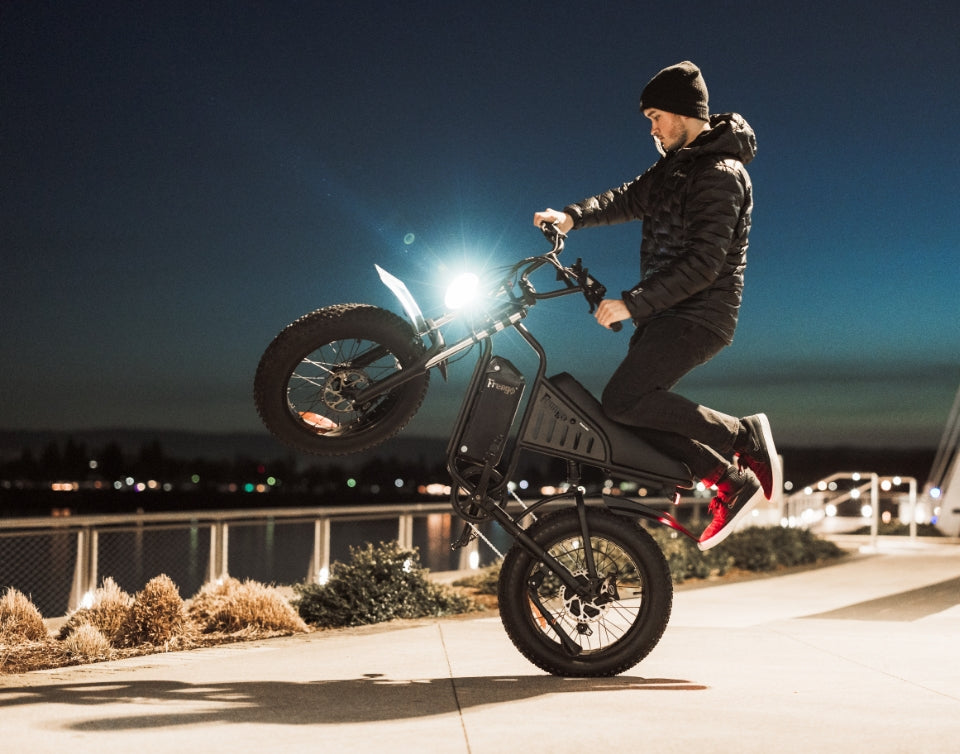
The Freego M3 is a compact non-folding e-bike. Its current published dimensions are 57.9 inches long and 36.6 inches high, with a net weight of approximately 55 pounds. The 16 × 4-inch tires and short frame reduce its overall footprint, but the frame does not collapse.
That design is a practical fit for riders who have enough storage length but want something smaller and easier to maneuver than many full-size fat-tire e-bikes. The M3 can make sense for a garage corner, ground-floor apartment, elevator building, campus housing with approved storage, or a vehicle whose measured cargo area is large enough.
The riding package includes a 600W nominal and 750W peak rear hub motor, a 48V 13Ah battery, front suspension, and front-and-rear hydraulic disc brakes. It is configured for a 20 mph top speed and is currently listed for riders from 4'7" to 5'11". Those specifications support short urban and campus rides, but they do not make the M3 a substitute for a folding bike when a transit operator or tiny trunk specifically requires one.
Choose the M3 when your main priorities are:
- A shorter, ready-to-ride frame with no folding step
- Approximately 55 pounds rather than a much heavier fat-tire platform
- 16 × 4-inch tires for a compact stance and everyday cushioning
- Hydraulic braking and front suspension for daily pavement
- Storage where the bike can remain assembled
For a closer look at its riding features, see Freego M3: Compact, Class 2, and Ready to Ride. Riders comparing other street-oriented options can also browse the Freego Class 2 e-bike collection.

Compact E-Bike vs Folding E-Bike Buying Checklist
- Measure the destination: Record the smallest doorway, elevator, closet, trunk opening, or transit limit.
- Compare complete dimensions: Use unfolded dimensions for compact bikes and both folded and unfolded dimensions for folding bikes.
- Check actual weight: Confirm whether the published number includes the battery.
- Plan the lift: Consider stairs, vehicle loading height, and safe gripping points.
- Check fit: Make sure rider height, seat position, reach, and brake access work for you.
- Review transportation rules: Check the current policy for every train, bus, airline, or building involved.
- Inspect charging space: Use the correct charger and keep charging away from exits and combustible clutter.
- Choose for normal use: Do not pay for a fold you will never use or buy a fixed frame that cannot fit where it needs to go.
Frequently Asked Questions
Is a compact e-bike the same as a folding e-bike?
No. A compact e-bike has a smaller overall footprint but may use a fixed frame. A folding e-bike uses hinges or latches to reduce its stored dimensions. Some folding bikes are compact when unfolded, but the terms are not interchangeable.
Is a folding e-bike always easier to carry?
No. Folding reduces size, not necessarily weight. Check net weight, battery removal, handholds, and the height of the lift. A heavy folding e-bike can still be difficult to carry upstairs or load into a vehicle.
Can a compact non-folding e-bike fit in a car trunk?
It depends on the bike and vehicle. Measure the trunk opening and usable cargo length, then compare them with the bike’s full dimensions. Hatchbacks and SUVs may accommodate a compact bike with rear seats folded, while a small sedan trunk may require a true folding model.
Is a compact e-bike good for an apartment?
It can be if the building has an elevator, ground-floor storage, or enough indoor space for the bike to remain assembled. In a walk-up apartment, weight may be more important than whether the frame folds.
Does the Freego M3 fold?
No. The Freego M3 is a compact fixed-frame e-bike. Its smaller 16-inch wheel platform and short frame reduce its footprint, but buyers should measure their storage area and vehicle rather than expecting it to fold.
Can I take the Freego M3 on a train?
Do not assume so. Train policies vary, and some distinguish true folding bikes from regular compact bikes while also limiting e-bike weight and tire width. Check the current operator and route rules before traveling.
Bottom Line
The right choice in a compact e-bike vs folding e-bike comparison depends on where the bike must fit and how often it must be lifted. Folding is valuable when the smallest possible package is essential. A compact fixed-frame model is often the simpler answer when there is enough storage length and the goal is easier everyday handling without a folding routine.
The Freego M3 belongs to the second category: compact, relatively light for a fat-tire e-bike, and ready to ride, but not foldable. Measure first, compare actual weight, verify transit rules, and choose the design that removes the biggest obstacle from your real daily trip.
References & Trusted Resources: U.S. Consumer Product Safety Commission Micromobility Battery Charging Safety; NHTSA Bicycle Safety; Amtrak Bicycle Policy. Freego M3 specifications were checked against the current U.S. product page at the time of writing.